 Trustpilot



LASEK / PRK Eye Surgery – A safe and effective laser vision correction solution for patients unsuitable for LASIK.
What is LASEK / PRK Eye Surgery?
LASEK (Laser-Assisted Epithelial Keratomileusis) and PRK (Photorefractive Keratectomy) are closely related treatments for vision correction.
The key difference lies in how the surface layer of the eye, the epithelium, is handled. In LASEK, the thin surface layer is gently moved aside and repositioned after the laser reshaping. In PRK, this layer is completely removed and naturally regenerates during recovery.
Both techniques reshape the cornea using a precise excimer laser to correct refractive errors like short-sightedness, long-sightedness, and astigmatism offering crisp, clear vision without glasses or contact lenses.
Who is LASEK / PRK Suitable For?
LASEK and PRK are excellent alternatives to LASIK especially for patients who may not be suitable for traditional laser eye surgery.
You may be a good candidate if:
- You have thin or irregular corneas
- You lead an active lifestyle or are in the military, where eye trauma risk is higher
- You’ve been told you’re not suitable for LASIK
- You prefer a ‘no flap’ procedure with minimal disruption to the eye
- You have dry eyes or a history of dry eye symptoms
Every eye is unique, which is why your suitability is always assessed carefully during a thorough consultation.
How Does LASEK / PRK Eye Surgery Work?
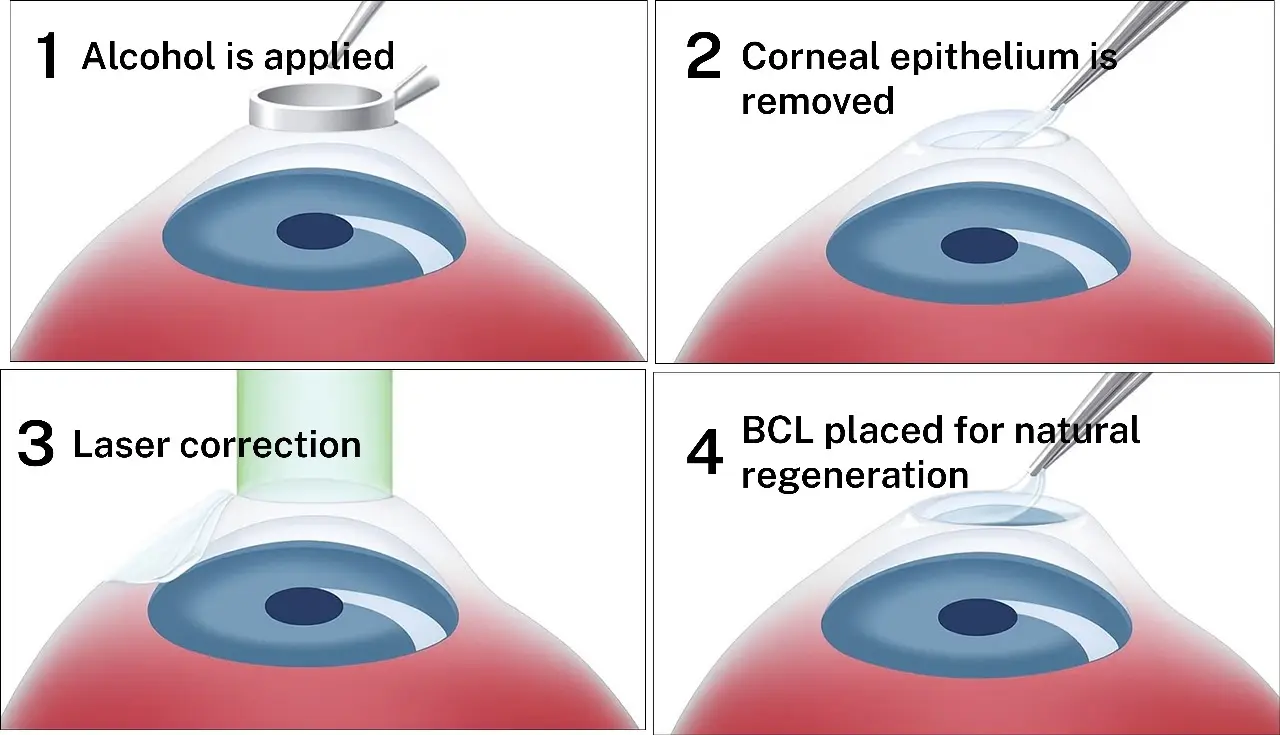
LASEK / PRK is a surface-based laser eye procedure and typically takes about 10–15 minutes per eye:
Here’s what happens during the procedure:
- Gentle removal of the outer layer:
The thin outer layer of the cornea (the epithelium) is either gently moved aside (in LASEK) or completely removed (in PRK). Don’t worry this layer naturally grows back within a few days. - Laser reshaping:
A highly precise laser is then used to reshape the corneal tissue underneath, correcting how light enters the eye improving your focus and clarity. - Protection and healing:
A special contact lens is placed on your eye to protect it while the surface layer heals. Most patients start to see improvements within a few days.
Because LASEK and PRK don’t involve cutting a flap in the cornea, they’re ideal for people with thin or irregular corneas, or those in physically demanding professions.
The procedure is pain-free, with most patients returning to work within 5–7 days.
Turn Your Vision into Reality with Mr. Rajesh Deshmukh!
Expert Guidance, Proven Results Let’s Build Your Success Story Together!
Recovery & Aftercare
Recovery from LASEK / PRK is slightly longer than LASIK but very manageable:
- You may experience some discomfort, light sensitivity, or blurred vision for the first few days.
- A protective temporary Bandage Contact Lens (BCL) will remain in place for 3–5 days to support healing.
- Most patients can return to work and normal activities within a week.
- Vision continues to sharpen over 1–2 weeks, with full results typically visible by 4–6 weeks.
- Regular follow-ups will ensure your healing is on track and your vision stabilises well.
- Avoid screen time, swimming, and eye rubbing during the first week
Mr. Deshmukh will personally guide you through post-op care and follow-ups.


Benefits of LASEK / PRK Surgery
- High success rates with long-term vision correction
- Suitable for thin or irregular corneas
- No corneal flap, reducing complication risk
- Minimal downtime and quick recovery
- Reduces or removes the need for glasses or contacts
- Ideal for active lifestyles and contact sports
Other Laser Eye Surgery Options
LASEK / PRK is one of several laser vision correction procedures available at our clinic. Depending on your eye health and lifestyle, you may also want to explore:
Not sure which one is best for you? Book a consultation with Mr. Deshmukh to receive a personalised treatment plan.

What to Expect: Before, During & After Surgery
Cataract surgery is a quick and highly effective procedure designed to restore your vision with minimal downtime. With Mr. Rajesh Dekhmukh’s expertise, you can expect precision, comfort, and a smooth recovery.
Step-by-Step Process

Before the Surgery: Preparation
Before undergoing laser cataract surgery, you will have a comprehensive eye examination to evaluate your vision and determine the best intraocular lens (IOL) for your needs. You may be advised to stop wearing contact lenses for a few days, avoid certain medications, and use prescribed eye drops to prepare your eyes for the procedure.
During the Surgery: What to Expect
- The procedure is performed under local anesthesia, ensuring comfort with no pain.
- A high-precision laser is used to create a tiny incision in the cornea.
- The laser softens the cloudy natural lens for a gentler and more precise removal.
- A premium intraocular lens (IOL) is implanted in its place to restore clear vision.
- The incision is self-sealing, so no stitches are required.
- The entire procedure takes 15-20 minutes per eye.

After the Surgery: Recovery & Restrictions
- Immediate improvement in vision is often noticeable within a day or two.
- You can resume most daily activities within 4 to 7 days, but avoid heavy lifting, swimming, and eye rubbing for a few weeks.
- Full recovery generally takes four to six weeks.
- Some patients experience temporary glare or halos, but these usually subside.
- Regular follow-ups ensure smooth recovery and optimal vision correction.
Why Choose Mr. Rajesh Deshmukh for LASEK / PRK?
- 20+ years of ophthalmic experience
- Consultant-level care in both NHS and private sectors
- Expertise in complex and surface-based laser surgeries
- Trusted by thousands of patients for clear, confident vision


EXCELLENT Based on 52 reviews
 Posted on Google
 Frederick NewallMr Deshmukh performed cataract surgery on both my eyes four weeks ago. The results have been excellent. My sight has improved dramatically, long medium and short. Mr Deshmukh gave me a clear understanding of the procedure and helpful post operationPosted on Google
 Jenni WatsonFor several years, I have been seeing Mr Deshmukh for suspected glaucoma and have been very impressed by his skill and sensitivity. When he suggested that now was the time to have cataract surgery, I had no hesitation in following his advice. He is very good at explaining the procedures and I opted for bilateral surgery with premium interocular lenses.I was slightly apprehensive before the operation but was reassured by all the staff. They were quite right as immediately afterwards I could read the notices in the corridor. It is wonderful not to be wearing glasses. I am 83 years old and cannot recommend Mr Deshmukh highly enough.Posted on Google
 E HawthornI can 100% recommend Mr. Rajesh Deshmukh for eye surgery. Mr. Deshmukh performed a cataract operation on my right eye during March 2024 and on my left eye eleven weeks later. In each case, it would have been possible to drive within two days after the operation. I drove after six days, as I do not drive every day. I can now read a car number plate at 63 metres. His whole medical team was very good at reducing my anxiety prior to the operations, which were painless. In each case, I would not have known that my eye had undergone an operation, other than the effects of the pupil dilation drops taking a full 24 hours to completely diminish. Before the operation, my eyes exceeded the legal requirement for driving, but the possibility of not being able to drive in the future was never going to be acceptable to me. I believe we forget how good our eyes once were, as changes happen very slowly over a very long time-period.Posted on Google
 Richard BoothI’m 58-year-old who had early onset of cataracts. The cataract surgery was complicated by some RK surgery I had around 25 years ago. The cataracts were affecting my golf, I was struggling to play tennis under floodlights and drive in the dark. I couldn’t be more pleased with the outcome. I now have perfect distance eyesight and can comfortably read texts on my phone and night vision is excellent. Mr Deshmukh took the time to understand my demands and complications with my eyesight. He clearly takes pride and interest in his work; I can’t recommend him highly enough.Posted on Google
 R DTwo excellent cataract operations. Both Rajesh and his assistant took excellent care of me last year and I will retain his services going forwardPosted on Google
 Caroline ThompsonMr Rajesh Deshmukh Carried out YAG laser treatment yesterday. The procedure was fast and very well preformed, the result today is very successful. Very happy with the care and treatment received, from Mr Deshmukh, the nursing team at MOORFIELDS and Mr Deshmukh PA Paula Jessup is of the highest level. Thank you for your all your support. Best regards Caroline ThompsonPosted on Google
 Exec DirDear Mr. Deshmukh, Thanks very much for a successful cataract surgery, done with such care and excellent skill. There were no complications and the result of the surgery is amazing! My sincere appreciation for the advice prior and after my surgery. I had no idea how beautiful my garden was until I came back home, to admire all the different flowers and plants, just to name a few. I would also like to thank your friendly and patient staff who took very good care of me. Warm regards, Monica BaetaPosted on Google
 Wahab WeliMy Both eyes cataract removal with lens exchange to correct vision has been carried out recently by Consultant ophthalmic surgeon Mr Ragesh Deshmuk in the private patient unit at Moorfields Eye Hospital in London. He also carried out follow-up consultations after the operation, the results were excellent for both eyes. I cannot believe I no longer need one after 40 years of using spectacles! I am thrilled with his excellent surgical ability. I am grateful for the exceptional care and skill Mr. Deshmukh and his team demonstrated in this matter. I also thank Ms Paula Jessup for her effort in arranging the timetables and all communications in this process. Wahab WeliPosted on Google
 zoe mcmillanMr Deshmukh carried out bilateral cataract surgery and insertion of trifocal lenses three weeks ago. The whole process was easy and reassuring. I can honestly say that the surgery itself was relaxing and pleasant - if you’re putting it off because you’re nervous - don’t be! This is the first time in nearly seventy years that I haven’t worn glasses and it’s life changing.
Our customers love us
Zulfikarali praised Mr Deshmukh for being honest and knowledgeable, and said he received excellent service and very good advice throughout his experience.
Stephen described a major improvement after cataract surgery and lens replacement. He praised the lens selection and said his near, intermediate and distance vision became excellent without needing glasses.
Chris described being very anxious because both eyes required surgery. He praised Mr Deshmukh's understanding, clear explanations and professionalism. Both eyes were treated together, recovery was smooth, and he reported significantly improved vision and a very positive experience with the Moorfields team.
Nonsense Tora described bilateral cataract surgery as quick and comfortable. Vision improved immediately, recovery was fast, and near and distance vision were significantly better after four weeks. The review also praised Mr Deshmukh's care and professionalism.
Gayle described Mr Deshmukh as highly recommended after being referred by a friend. The review explains that complex cataract surgery led to a major improvement in vision and greatly reduced the need for reading glasses.
Regarding Laser Cataract Surgery Services
01. What is laser cataract surgery, and how does it differ from traditional cataract surgery?
Laser cataract surgery uses advanced laser technology to create precise incisions and soften the cataract-affected lens before removal. This technique enhances accuracy, reduces surgical trauma, and improves visual outcomes compared to traditional manual cataract surgery.
02. Who is an ideal candidate for laser cataract surgery performed by Mr. Deshmukh?
Patients diagnosed with cataracts who seek a more precise and minimally invasive approach to lens removal may benefit from laser cataract surgery. Mr. Deshmukh evaluates each case individually to determine suitability.
03. What are the advantages of choosing laser cataract surgery by Mr. Deshmukh over traditional cataract surgery?
Laser cataract surgery offers enhanced precision, reduced risk of complications, and a faster recovery time. The laser-assisted technique allows for customized lens positioning, leading to improved vision correction.
04. What types of intraocular lenses (IOLs) are available for laser cataract surgery, and how does Mr. Deshmukh determine the most suitable lens for each patient?
Laser cataract surgery can be performed with various IOLs, including monofocal, multifocal, toric, and EDOF lenses. Mr. Deshmukh assesses the patient’s vision requirements and lifestyle to select the most suitable lens for optimal results.
05. How long does it take to recover from laser cataract surgery, and what can patients expect during the recovery period?
Most patients experience vision improvement within a few days. Some may have temporary glare or halos, but these effects usually diminish over time. Mr. Deshmukh provides comprehensive post-operative care instructions to support a smooth recovery.
Availability
This procedure is available at My-iclinic and Harley street eye centre, performed personally by Mr. Rajesh Deshmukh.

