 Trustpilot



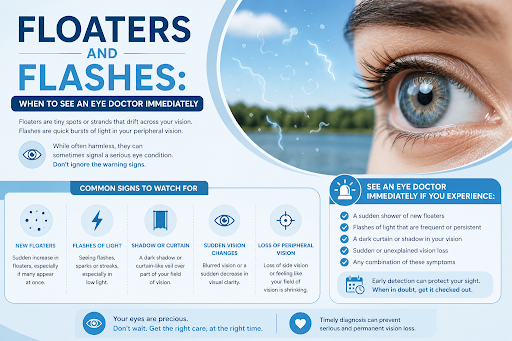
Have you ever noticed tiny black spots, cobweb-like strands, or flashing lights in your vision? These visual disturbances, known as eye floaters and flashes, are common and often harmless, especially as we age. However, in some cases, they can be the first warning signs of a serious retinal condition that requires immediate medical attention.
Ignoring sudden changes in your vision could lead to permanent vision loss if conditions such as a retinal tear or retinal detachment are left untreated.
In this guide, we’ll explain what floaters and flashes are, why they occur, when they’re considered normal, and the warning signs that mean you should see an eye doctor immediately.
What Are Eye Floaters?
Eye floaters are tiny shapes that drift across your field of vision. They may appear as:
- Small black or grey dots
- Thread-like strands
- Cobwebs
- Squiggly lines
- Transparent circles
- Shadowy spots
Floaters are most noticeable when looking at a bright background, such as a clear sky, a white wall, or a computer screen.
Although they seem to move in front of your eyes, floaters are actually tiny clumps inside thevitreous humour, the clear gel that fills the inside of the eye.
What Causes Eye Floaters?
1. Age-Related Changes
The most common cause of floaters is the natural ageing process.
As we get older, the vitreous gel becomes more liquid and begins to shrink. Tiny collagen fibres inside the vitreous can clump together, casting shadows on the retina that appear as floaters.
This process is known as posterior vitreous detachment (PVD) and is common after the age of 50.
2. Nearsightedness (Myopia)
People with moderate or high myopia are more likely to develop floaters earlier in life because the vitreous may change sooner.
3. Eye Injury
Trauma to the eye can disturb the vitreous gel and lead to the sudden appearance of floaters.
4. Eye Surgery
Some people notice floaters after procedures such as cataract surgery due to changes within the eye.
5. Inflammation or Infection
Conditions affecting the back of the eye, including inflammation (uveitis) or certain infections, may cause inflammatory cells to appear as floaters.
What Are Eye Flashes?
Eye flashes are brief bursts or streaks of light that appear without an external light source.
People often describe them as:
- Lightning streaks
- Camera flashes
- Sparkles
- Flickering lights
Flashes usually occur because the vitreous gel pulls on the retina, stimulating the light-sensitive cells.
Common Causes of Eye Flashes
Posterior Vitreous Detachment (PVD)
As the vitreous separates from the retina, it may create flashes of light. In many cases, this is a normal part of ageing.
However, if the vitreous pulls too strongly, it can create a retinal tear.
Retinal Tear
A retinal tear occurs when the retina develops a small break.
Without prompt treatment, fluid can pass through the tear and lift the retina away from the back of the eye.
This condition can progress to retinal detachment.
Retinal Detachment
Retinal detachment is a medical emergency that requires immediate treatment.
Without urgent surgery, permanent vision loss can occur.
Migraine Aura
Some people experience flashing lights as part of a migraine aura.
These flashes usually:
- Affect both eyes
- Last between 10 and 30 minutes
- May occur before a headache
Unlike retinal flashes, migraine-related visual symptoms often appear as zigzag patterns or shimmering lights.
Floaters vs Flashes: What's the Difference?
| Feature | Floaters | Flashes |
| Appearance | Spots, threads, cobwebs | Brief flashes or streaks of light |
| Cause | Changes in the vitreous gel | Pulling or traction on the retina |
| Movement | Drift with eye movement | Appear suddenly and disappear quickly |
| Common With Age | Yes | Yes |
| Can Signal Emergency | Yes, if sudden or numerous | Yes, especially if new or persistent |
When Should You See an Eye Doctor Immediately?
While many floaters are harmless, certain symptoms require urgent medical assessment.
Seek immediate eye care if you notice:
A Sudden Increase in Floaters
A rapid shower of new floaters can indicate a retinal tear or bleeding inside the eye.
Persistent Flashes of Light
Frequent or recurring flashes may suggest that the retina is being pulled or torn.
A Curtain or Shadow Over Your Vision
If you notice a dark curtain, shadow, or veil moving across your vision, this may indicate retinal detachment.
This requires emergency treatment.
Sudden Vision Loss
Any sudden reduction in vision should be assessed immediately.
Floaters After an Eye Injury
New floaters or flashes following trauma should never be ignored.
Floaters with Eye Pain or Redness
Although simple floaters are usually painless, pain or redness may indicate inflammation or another serious eye condition.
Who Is at Higher Risk?
Certain people are more likely to develop retinal tears or detachments.
Risk factors include:
- Age over 50
- High myopia (severe short-sightedness)
- Previous retinal tear or detachment
- Family history of retinal detachment
- Previous cataract surgery
- Eye injury
- Diabetes affecting the retina
If you have one or more of these risk factors, regular retinal examinations are especially important.
How Are Floaters and Flashes Diagnosed?
An ophthalmologist will perform a comprehensive eye examination, which may include:
Dilated Retinal Examination
Eye drops are used to enlarge the pupils, allowing the retina to be examined thoroughly.
Optical Coherence Tomography (OCT)
OCT creates detailed cross-sectional images of the retina and macula.
Ocular Ultrasound
If bleeding prevents a clear view of the retina, an ultrasound scan may be performed.
Treatment Options
Treatment depends on the underlying cause.
Harmless Floaters
Most age-related floaters do not require treatment.
Over time, many people become less aware of them as the brain adapts.
Posterior Vitreous Detachment
PVD itself usually requires monitoring rather than treatment, but follow-up examinations are important to ensure no retinal tear develops.
Retinal Tear
Small retinal tears can often be treated using:
- Laser photocoagulation
- Cryotherapy (freezing treatment)
Early treatment can prevent retinal detachment.
Retinal Detachment
Retinal detachment usually requires surgery.
Depending on the situation, treatment may include:
- Vitrectomy
- Scleral buckle surgery
- Pneumatic retinopexy
Prompt treatment offers the best chance of preserving vision.
Can Floaters Be Prevented?
Most age-related floaters cannot be prevented.
However, you can support long-term eye health by:
- Having regular comprehensive eye examinations
- Managing diabetes and blood pressure
- Wearing protective eyewear during sports and hazardous activities
- Seeking prompt medical care for new visual symptoms
- Following up after eye surgery as recommended
Frequently Asked Questions
Are floaters normal as you get older?
Yes. Many people develop floaters as part of the natural ageing process. However, a sudden increase should always be assessed by an eye specialist.
Do floaters go away?
Floaters often become less noticeable over time because they settle below the line of sight, and the brain gradually adapts. Some may remain permanently but become less bothersome.
Are flashes always serious?
Not always. Flashes can occur during normal age-related changes in the vitreous, but persistent or sudden flashes require an urgent retinal examination to rule out a retinal tear.
Can retinal detachment cause blindness?
Yes. Without prompt treatment, retinal detachment can result in permanent vision loss. Early diagnosis and surgery provide the best chance of preserving sight.
Tips for Protecting Your Vision
To reduce the risk of serious complications:
- Schedule regular eye examinations, particularly after age 50.
- Seek immediate care for new floaters or flashes.
- Protect your eyes from injury by wearing safety eyewear.
- Control diabetes and high blood pressure.
- Follow your ophthalmologist’s advice after eye surgery.
Conclusion
Eye floaters and flashes are common, particularly as we age, and are often caused by normal changes within the vitreous. However, a sudden increase in floaters, recurring flashes of light, or the appearance of a curtain over your vision can signal a retinal tear or retinal detachment—conditions that require urgent medical attention.
The safest approach is never to ignore sudden changes in your vision. A prompt examination by an ophthalmologist can identify the cause, provide appropriate treatment if necessary, and help protect your eyesight. Early diagnosis remains the best way to prevent permanent vision loss and maintain lifelong eye health.

