 Trustpilot



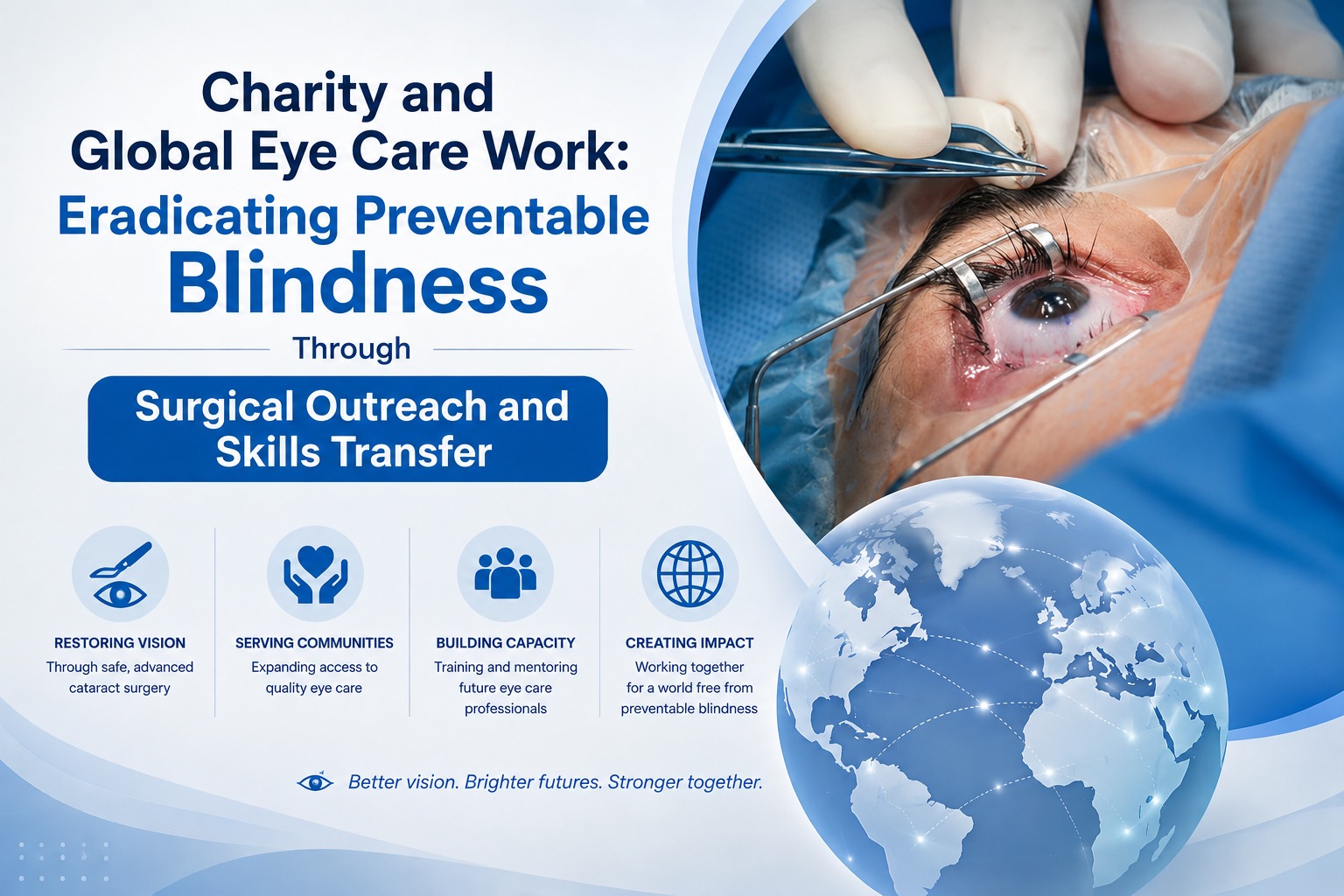
Cataract surgery is widely recognized as one of the most reliable, safe, and cost-effective procedures in modern medicine. In my daily clinical practice as a consultant ophthalmic surgeon at Moorfields Eye Hospital in London, performing advanced cataract surgery and lens replacement is routine. With state-of-the-art diagnostic imaging, high-precision phacoemulsification technology, and premium intraocular lenses, restoring clear vision to patients in the United Kingdom is a dependable, outpatient reality.
Yet, when we look beyond the developed world, vision loss presents a radically different picture. According to the World Health Organization (WHO) Blindness and Visual Impairment Data, cataracts remain the single leading cause of avoidable blindness globally, accounting for tens of millions of blind or visually impaired individuals. Over 90% of these individuals reside in low- and middle-income countries.
The tragedy of this global burden is not clinical complexity; it is a profound crisis of geographic and economic access. In rural and underprivileged communities, men and women do not lose their sight because their cataracts are incurable. They lose their sight because the standard surgical intervention is financially out of reach or unavailable within their regional infrastructure. A dense cataract transforms an independent breadwinner or elder into someone dependent on others, pulling younger family members out of education or employment to provide care. When sight is restored, entire families and communities are unlocked from poverty.
To address this systemic disparity, my charitable and outreach work is structured around a two-pronged philosophy: direct surgical funding to clear immediate backlogs of blindness, and sustainable surgical training to empower local clinicians for the future.
The Dual-Track Framework: Direct Relief and Long-Term Capacity
International humanitarian ophthalmology has historically relied on visiting surgical teams who fly into a region, operate intensively for a few days, and depart. While these missions bring vital immediate relief to the individuals treated, they do not resolve the underlying systemic void once the visiting team packs their equipment.
My global eye care commitments are built on an enduring framework:
- Direct Humanitarian Funding: Subsidizing high-volume, high-quality cataract surgery for marginalized patients who cannot afford basic clinical fees.
- Institutional Skills Transfer (MSICS Training): Equipping domestic and international ophthalmic surgeons with surgical techniques that do not rely on expensive, fragile Western technology, creating self-sustaining local surgical centres.
The Prayag Vision Foundation: Championing Sustainable Eye Care
At the centre of our long-term outreach is the Prayag Vision Foundation. The Foundation was established with a clear mandate: to improve equitable access to high-standard eye care for underserved populations and to support long-term training and clinical infrastructure rather than isolated, temporary interventions.
The Foundation works in direct coordination with accredited regional medical partners, most notably the Rotary Eye Hospital in Dharashiv (Maharashtra, India). By integrating with established local institutions, we ensure that every initiative undergoes rigorous pre-operative screening, comprehensive surgical execution in sterile theatre environments, and meticulous post-operative follow-up.
This institutional collaboration addresses preventable blindness at its root by providing free transport from rural villages, diagnostic biometry, modern intraocular lens implantation, and essential post-operative medications to patients who would otherwise remain untreated.
High-Altitude Expeditions: Transforming Physical Challenges into Surgical Outcomes
I have long had a passion for high-altitude trekking. Whenever I take on a demanding mountain trail, I seek to connect the physical exertion to a meaningful clinical purpose. Mountain expeditions require endurance, preparation, and resilience—qualities that mirror the journey of overcoming health challenges and fighting global health inequalities.
1. Everest Base Camp (2026): Funding 100 Sight-Restoring Surgeries
In March 2026, I embarked on a trek to Everest Base Camp in the Himalayas. Before setting out on the trail, I launched an appeal to fund approximately one hundred cataract operations in rural India. The economic arithmetic was compelling: in this setting, a contribution of approximately £30 ($38 USD / ₹3,200 INR) covers the complete cost of a patient’s surgery, including the intraocular lens and perioperative medications.
Following the trek, all 100 cataract surgeries were successfully funded and completed during June and July 2026 at the Rotary Eye Hospital in Dharashiv. You can read the complete patient impact and campaign details in our dedicated report: One Hundred Cataract Surgeries, Completed: From Everest Base Camp Appeal to Restoring Sight in India.
2. Annapurna Base Camp (2023): Supporting Moorfields Eye Charity
In May 2023, I undertook the trek to Annapurna Base Camp in Nepal, raising over £2,000 for Moorfields Eye Charity. This initiative helped fund vital ophthalmic research, education, and patient care initiatives supported by Moorfields in the United Kingdom and globally.
These expeditions demonstrated that personal milestones and physical recovery can be channelled directly into tangible, life-altering medical interventions for those in acute need.
Training Surgeons: The MSICS Course at Moorfields City Road
While funding one hundred operations restores sight to one hundred individuals, training a single ophthalmic surgeon restores sight to thousands of patients across an entire career. For this reason, surgical education forms the most vital pillar of our global health contribution.
At Moorfields Eye Hospital (City Road, London), I run a specialized training course in Manual Small Incision Cataract Surgery (MSICS) designed for experienced ophthalmologists and senior surgical trainees.
Why MSICS is the Gold Standard for Global Eye Care
In high-income Western healthcare systems, the primary surgical modality for cataracts is phacoemulsification. While phacoemulsification delivers superb outcomes, it requires sophisticated ultrasound machines costing tens of thousands of pounds, expensive single-use disposable cassettes, uninterrupted high-voltage electricity, and specialized biomedical maintenance. In rural, low-resource settings, these dependencies create significant barriers to care.
Manual Small Incision Cataract Surgery (MSICS) offers a transformative alternative:
- No Machine Reliance: MSICS achieves cataract extraction through a self-sealing, sutureless scleral tunnel incision without relying on powered phacoemulsification consoles.
- Superior for Dense, Mature Cataracts: Patients in developing nations frequently present with advanced, rock-hard “hypermature” cataracts that are hazardous and difficult to emulsify with ultrasound. MSICS enables safe, complete manual extraction of intact lenses.
- Speed and Cost-Efficiency: MSICS can be performed rapidly and safely in high-volume settings at a fraction of the per-case cost of phacoemulsification, without compromising on visual outcomes or safety profiles.
- Universal Surgical Portability: An ophthalmologist trained in MSICS at Moorfields possesses the surgical versatility to deliver world-class cataract surgery in any operating theatre worldwide, regardless of infrastructure constraints.
Strategic Comparison: Short-Term Missions vs. Sustainable Capacity Building
| Feature / Dimension | Traditional Short-Term Surgical Camps | Sustainable Model (Prayag Vision & MSICS Training) |
|---|---|---|
| Operational Approach | External surgical teams visit temporarily for 3–7 days. | Permanent partnerships with local surgical hospitals (e.g., Rotary Eye Hospital Dharashiv). |
| Surgical Technology | Often constrained by transportable Western equipment. | High-volume, sutureless MSICS optimized for local environments and dense cataracts. |
| Long-Term Capacity | Ceases when the foreign medical team departs. | Continuous local care bolstered by formal MSICS surgical training at Moorfields. |
| Post-Operative Safety | Follow-up care can be fragmented once teams leave. | Integrated local follow-up protocols managed by permanent resident clinical staff. |
| Cost-Effectiveness | High logistics, travel, and machine maintenance overheads. | Highly cost-efficient (~£30 per operation) with maximum community impact. |
Looking Ahead: Ongoing Commitments & Global Outreach
Preventable blindness is an issue with a clear medical solution. The challenge of our generation is building the delivery pipelines and human expertise to bring that solution to every corner of the world.
Our work remains ongoing:
- The Prayag Vision Foundation continues to identify high-need rural districts in India for subsidised surgical camps.
- The MSICS Surgical Course at Moorfields continues to train new cohorts of international ophthalmic surgeons.
- Future high-altitude treks are planned to generate sustained funding and awareness for global eye health initiatives.
If you are interested in learning more about the Prayag Vision Foundation, enrolling in the MSICS surgical training course, or supporting future charitable ophthalmic appeals, please get in touch.
About Mr Rajesh Deshmukh, Consultant Ophthalmic Surgeon
Mr Rajesh Deshmukh (MBBS, FRCOphth, FRCS Glasg) is a Consultant Ophthalmic Surgeon at the world-renowned Moorfields Eye Hospital NHS Foundation Trust, London. He specializes in cataract surgery, refractive lens exchange, and advanced vision correction.
Alongside his UK private and NHS clinical practice, Mr Deshmukh is committed to global humanitarian ophthalmology, leading charitable cataract surgical programmes through the Prayag Vision Foundation and directing MSICS surgical training for international ophthalmologists at Moorfields City Road.
For private ophthalmic consultations, cataract evaluations, or second opinions in London, appointments can be arranged here.
5. FAQ
Q1: What is the primary cause of preventable blindness worldwide?
A: According to the World Health Organization (WHO), untreated cataracts remain the leading cause of preventable blindness globally, particularly in low- and middle-income nations where access to affordable surgical eye care is limited.
Q2: How does Mr Rajesh Deshmukh support global eye care?
A: Mr Rajesh Deshmukh supports global ophthalmology through a dual model: directly funding free cataract operations for underserved communities via the Prayag Vision Foundation and Rotary Eye Hospital Dharashiv, and training international eye surgeons in Manual Small Incision Cataract Surgery (MSICS) at Moorfields Eye Hospital in London.
Q3: How much does it cost to fund a cataract surgery in India through this initiative?
A: Approximately £30 (roughly $38 USD or ₹3,200 INR) covers the complete cost of one sight-restoring cataract operation in rural India, including pre-operative screening, the surgical procedure, intraocular lens (IOL) implantation, and immediate post-operative medical care.
Q4: What is Manual Small Incision Cataract Surgery (MSICS)?
A: Manual Small Incision Cataract Surgery (MSICS) is a high-volume, cost-effective cataract extraction technique that utilizes a self-sealing scleral tunnel incision. Unlike Western phacoemulsification, MSICS does not require expensive ultrasound machines or high-voltage electrical supplies, making it ideal for treating dense, mature cataracts in resource-limited global settings.
Q5: Where were the 100 cataract surgeries completed following the Everest Base Camp trek?
A: All 100 surgeries were performed during June and July 2026 at the Rotary Eye Hospital in Dharashiv (Maharashtra, India), in collaboration with the Prayag Vision Foundation.
Q6: How can ophthalmologists enroll in the MSICS training course at Moorfields?
A: Experienced ophthalmologists and senior surgical trainees interested in the MSICS course at Moorfields Eye Hospital City Road can reach out via the official website contact page at rajeshdeshmukh.co.uk/contact/ for upcoming course dates and syllabus information.

