 Trustpilot



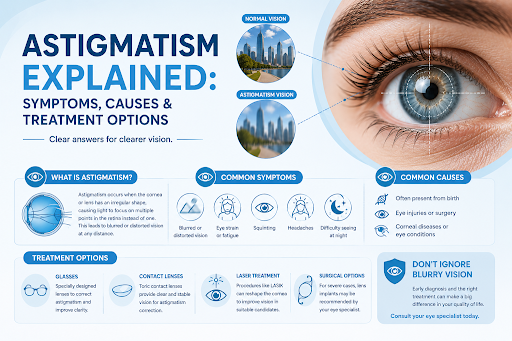
If road signs appear blurry, lights seem to have halos at night, or you often experience headaches after reading or using a computer, astigmatism may be the cause. Astigmatism is one of the most common refractive errors, affecting people of all ages. It occurs when the eye cannot focus light evenly onto the retina, resulting in blurred or distorted vision at all distances.
The good news is that astigmatism is usually easy to diagnose and can be effectively corrected with glasses, contact lenses, or vision correction procedures such as LASIK or Refractive Lens Exchange (RLE) for suitable candidates.
In this guide, we’ll explain what astigmatism is, why it develops, its symptoms, how it is diagnosed, and the treatment options available to help you achieve clearer vision.
What Is Astigmatism?
Astigmatism is a refractive error that occurs when the cornea (the clear front surface of the eye) or, less commonly, the natural lens has an irregular shape.
A normal cornea is round like a football (soccer ball), allowing light rays to focus at a single point on the retina. In astigmatism, the cornea is shaped more like a rugby ball or an egg, causing light to focus at multiple points instead of one.
As a result, vision becomes blurred or distorted at both near and far distances.
How Does Astigmatism Affect Vision?
When light enters an eye with astigmatism, it cannot focus precisely on the retina.
This may cause:
- Blurred vision
- Distorted images
- Difficulty focusing
- Halos around lights
- Reduced night vision
The amount of blur depends on the severity of the astigmatism.
Types of Astigmatism
Corneal Astigmatism
This is the most common type and occurs when the cornea has an irregular curvature.
Lenticular Astigmatism
This occurs when the natural lens inside the eye has an irregular shape.
It is less common but may develop with ageing or certain eye conditions.
Regular Astigmatism
The principal curves of the cornea are perpendicular to each other.
This is the most common form and is usually correctable with glasses or contact lenses.
Irregular Astigmatism
The corneal surface is uneven and not symmetrical.
Possible causes include:
- Keratoconus
- Corneal injury
- Corneal scarring
- Previous eye surgery
Irregular astigmatism often requires specialised treatment.
Symptoms of Astigmatism
Symptoms vary depending on the severity of the refractive error.
Common symptoms include:
- Blurred vision
- Distorted vision
- Difficulty seeing fine details
- Eye strain
- Frequent headaches
- Squinting
- Difficulty driving at night
- Halos around lights
- Double vision in some cases
- Fatigue after reading or computer use
Children may not realise their vision is abnormal, making regular eye examinations especially important.
What Causes Astigmatism?
In many people, astigmatism is present from birth and may run in families.
Other causes include:
Genetics
Many cases are inherited.
Keratoconus
This progressive condition causes the cornea to become thinner and more cone-shaped, leading to increasing astigmatism.
Eye Injury
Trauma may change the shape of the cornea.
Previous Eye Surgery
Some surgical procedures can alter the curvature of the cornea.
Cataracts
Changes in the natural lens may occasionally contribute to lenticular astigmatism.
Risk Factors
You may be more likely to develop astigmatism if you have:
- A family history of astigmatism
- High myopia (short-sightedness)
- Hyperopia (long-sightedness)
- Keratoconus
- Previous eye surgery
- Corneal scarring
- Eye trauma
How Is Astigmatism Diagnosed?
A comprehensive eye examination can accurately diagnose astigmatism.
Your ophthalmologist or optometrist may perform:
Visual Acuity Test
Measures how clearly you can see letters at different distances.
Refraction Test
Determines the exact prescription required to correct your vision.
Keratometry
Measures the curvature of the cornea.
Corneal Topography
Creates a detailed map of the corneal surface.
This is particularly useful for:
- Detecting keratoconus
- Planning LASIK
- Assessing irregular astigmatism
Slit Lamp Examination
Allows your ophthalmologist to examine the front of the eye for abnormalities.
Treatment Options for Astigmatism
Treatment depends on the severity of your astigmatism, your age, lifestyle, and overall eye health.
Prescription Glasses
For many people, glasses are the simplest and most effective treatment.
Special cylindrical lenses compensate for the uneven curvature of the cornea.
Toric Contact Lenses
Unlike standard contact lenses, toric lenses are specifically designed to correct astigmatism.
Options include:
- Daily disposable lenses
- Monthly lenses
- Soft toric lenses
- Rigid gas-permeable (RGP) lenses
Your eye care professional will recommend the most suitable type.
LASIK Eye Surgery
LASIK uses a laser to reshape the cornea, correcting astigmatism by creating a more regular surface.
LASIK may be suitable if you:
- Have a stable prescription
- Have healthy corneas
- Meet the required eligibility criteria
Many patients achieve excellent vision with minimal recovery time.
PRK and LASEK
For patients with thinner corneas, surface laser procedures such as PRK or LASEK may be recommended instead of LASIK.
SMILE Laser Eye Surgery
SMILE (Small Incision Lenticule Extraction) is another minimally invasive laser vision correction option for selected patients with myopia and certain degrees of astigmatism.
Refractive Lens Exchange (RLE)
For patients over 45 with presbyopia or early cataracts, Refractive Lens Exchange using toric intraocular lenses (IOLs) can correct astigmatism while reducing dependence on glasses.
Can Astigmatism Be Prevented?
Astigmatism itself cannot usually be prevented because it is often inherited.
However, you can protect your overall eye health by:
- Having regular comprehensive eye examinations
- Wearing protective eyewear during sports and hazardous activities
- Managing conditions such as diabetes
- Seeking prompt treatment for eye injuries
Astigmatism in Children
Astigmatism is common in children and may affect learning if left uncorrected.
Possible signs include:
- Squinting
- Sitting close to the television
- Holding books very close
- Frequent headaches
- Poor concentration during reading
Routine eye examinations are essential because children often do not realise they have blurred vision.
Frequently Asked Questions
Is astigmatism serious?
In most cases, no. Astigmatism is a common refractive error that can usually be corrected successfully with glasses, contact lenses, or surgery.
Can astigmatism get worse?
Yes. It may gradually change over time, particularly if caused by conditions such as keratoconus or age-related changes in the eye.
Can LASIK permanently correct astigmatism?
For suitable candidates, LASIK provides long-lasting correction of astigmatism. However, natural age-related changes such as presbyopia or cataracts may still occur later in life.
Does everyone with astigmatism need treatment?
Not necessarily. Mild astigmatism may not cause noticeable symptoms. Treatment is recommended when vision becomes blurred or daily activities are affected.
Tips for Living with Astigmatism
To maintain comfortable vision:
- Wear your prescribed glasses or contact lenses consistently.
- Attend routine eye examinations.
- Follow the 20-20-20 rule during prolonged screen use.
- Ensure good lighting when reading or working.
- Avoid driving at night if your vision is significantly blurred until corrected.
- Discuss laser vision correction if you wish to reduce dependence on glasses.
Conclusion
Astigmatism is a common and highly treatable refractive error caused by an irregularly shaped cornea or lens. Although it can lead to blurred vision, headaches, and eye strain, modern diagnostic technology makes it easy to detect, and a wide range of effective treatment options are available.
Whether you need prescription glasses, toric contact lenses, LASIK, or refractive lens exchange, early diagnosis and personalised care can help you achieve clear, comfortable vision. If you’re experiencing persistent blurred vision or frequent headaches, schedule a comprehensive eye examination with an ophthalmologist to determine the best solution for your eyes.

