 Trustpilot



Introduction
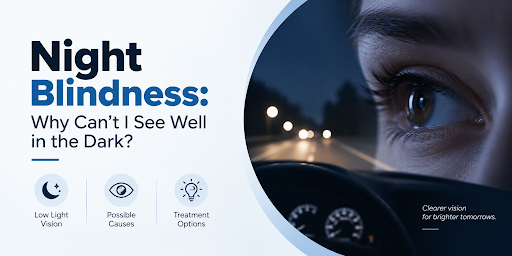
Do you struggle to see clearly when driving at night, walking through a dimly lit room, or moving from a bright environment into darkness? Difficulty seeing in low-light conditions is commonly called night blindness, or nyctalopia.
Night blindness is not usually a condition on its own. Instead, it is a symptom that can have several possible causes, ranging from an uncorrected glasses prescription to conditions affecting the retina.
Occasional difficulty adjusting to darkness can be normal, but persistent or worsening problems with night vision deserve an eye examination. Identifying the underlying cause early can help protect your vision and determine whether treatment is available.
What Is Night Blindness?
Night blindness refers to difficulty seeing in dim or dark environments.
Someone with night blindness may have relatively normal vision during the day but struggle when:
- Entering a dark room
- Driving at night
- Walking outdoors after sunset
- Moving between bright and dim areas
- Seeing objects in poorly lit environments
The ability to see in low light depends heavily on the retina, particularly specialised cells called rod photoreceptors.
These cells help your eyes detect light when illumination is low. Problems affecting the retina, the eye’s optics, or visual adaptation can therefore affect night vision.
Is Night Blindness the Same as Poor Eyesight?
Not necessarily.
A person can have good daytime vision but still experience significant difficulty seeing at night.
For example, someone may be able to read a chart clearly during a daytime eye examination but struggle with:
- Glare from headlights
- Dim roads
- Poorly illuminated signs
- Objects appearing suddenly in low light
This is why telling your eye doctor specifically about night-time vision problems is important.
Common Symptoms of Night Blindness
Symptoms can vary depending on the underlying cause.
You may notice:
- Difficulty seeing in dim lighting
- Slow adjustment when moving from light to darkness
- Difficulty driving at night
- Increased sensitivity to headlights
- Glare or halos around lights
- Difficulty identifying objects in poorly lit areas
- Reduced confidence walking in dark environments
- Needing brighter lighting to read or perform tasks
If these symptoms are new or becoming worse, arrange a comprehensive eye examination.
What Causes Night Blindness?
There are several possible causes.
1. Short-Sightedness (Myopia)
Uncorrected or inadequately corrected myopia can make distant objects appear particularly unclear at night.
Night-time conditions can make this more noticeable because pupils become larger in darkness, potentially increasing optical blur.
An updated glasses or contact lens prescription may improve the problem when refractive error is the main cause.
2. Cataracts
Cataracts occur when the natural lens inside the eye becomes cloudy.
They can cause:
- Blurred vision
- Glare
- Halos around lights
- Reduced contrast
- Difficulty seeing at night
Night driving can become particularly challenging because headlights may appear excessively bright or scattered.
If cataracts are significantly affecting everyday activities, cataract surgery may be considered.
3. Retinitis Pigmentosa
Retinitis pigmentosa (RP) is a group of inherited retinal disorders that can progressively affect rod photoreceptors.
One of the early symptoms may be difficulty seeing in dim light.
Other symptoms can include gradual loss of peripheral vision.
If night blindness develops at a young age or there is a family history of inherited retinal disease, specialist retinal assessment may be appropriate.
4. Vitamin A Deficiency
Vitamin A plays an important role in normal retinal function.
Severe vitamin A deficiency can cause impaired night vision. However, in countries where nutritional deficiency is uncommon, it is not the most frequent explanation for night blindness.
Do not take high-dose vitamin A supplements without medical advice, as excessive vitamin A can be harmful.
5. Glaucoma and Certain Eye Treatments
Advanced eye disease and some medications can affect visual function in ways that make low-light vision more difficult.
A comprehensive examination can help determine whether an underlying eye condition is contributing to your symptoms.
6. Diabetic Retinopathy
Diabetes can damage blood vessels in the retina.
As diabetic retinal disease progresses, vision may become affected, including the ability to see clearly in challenging lighting conditions.
Regular diabetic eye screening is therefore important for people with diabetes.
7. Retinal Disorders
Several diseases affecting the retina can interfere with night vision.
These may include:
- Inherited retinal disorders
- Retinal degeneration
- Retinal inflammation
- Other diseases affecting photoreceptors
Specialist retinal imaging and testing may be needed when a retinal cause is suspected.
Why Is Night Driving Sometimes Difficult?
Night driving combines several challenges for the visual system.
Your eyes need to:
- Detect objects in low light
- Adjust rapidly between different levels of illumination
- Handle bright headlights
- Recognise road signs
- Judge distances
- Detect pedestrians and cyclists
- Maintain peripheral awareness
Conditions such as cataracts, uncorrected refractive errors, dry eye, and certain retinal disorders can make these tasks more difficult.
If you do not feel that you can see safely while driving at night, avoid driving until your vision has been assessed and corrected where possible.
Night Blindness and Cataracts
Cataracts are a particularly common cause of increasing difficulty with night vision in older adults.
A cloudy lens scatters incoming light, which can produce glare and halos, especially around headlights and streetlights.
If cataracts are affecting your quality of life, an ophthalmologist can assess whether cataract surgery could improve your vision.
How Is Night Blindness Diagnosed?
Your eye doctor will first determine whether the problem is caused by a refractive error or another eye condition.
A comprehensive examination may include:
Visual Acuity Testing
Checks how clearly you can see at different distances.
Refraction
Determines whether glasses or contact lenses could improve your vision.
Slit-Lamp Examination
Allows the ophthalmologist to examine the cornea, lens, and other structures at the front of the eye.
Dilated Retinal Examination
The pupils are enlarged with eye drops so the retina and optic nerve can be examined in greater detail.
OCT Scan
Optical Coherence Tomography (OCT) provides detailed cross-sectional images of the retina and can help identify structural abnormalities.
Visual Field Testing
This assesses your peripheral vision and can be particularly useful when glaucoma or retinal disease is suspected.
Electroretinography
In selected cases, an electroretinogram (ERG) may be used to assess how the retina responds to light, particularly when an inherited retinal disorder is suspected.
Treatment for Night Blindness
There is no single treatment because management depends on the underlying cause.
Correcting Your Glasses Prescription
If refractive error is responsible, updating your prescription may significantly improve night-time vision.
Cataract Surgery
If cataracts are responsible for glare and poor night vision, removing the cloudy natural lens and replacing it with an intraocular lens (IOL) can restore clearer vision.
Treating Underlying Eye Disease
Conditions such as glaucoma, diabetic retinopathy, or retinal disease require treatment based on the specific diagnosis.
Managing Nutritional Deficiency
If vitamin A deficiency is confirmed, your doctor may recommend appropriate dietary changes or supplementation.
Vitamin supplements should not be taken at high doses without professional advice.
Can Night Blindness Be Prevented?
Not every cause of night blindness can be prevented, particularly inherited retinal disorders.
However, good eye care can reduce the risk of some vision problems.
Have Regular Eye Examinations
Routine examinations can detect cataracts, glaucoma, retinal disease, and refractive errors before they significantly affect vision.
Manage Diabetes and Blood Pressure
Good control of underlying health conditions can reduce the risk of certain retinal complications.
Protect Your Eyes
Use appropriate protective eyewear during activities where eye injury is possible.
Maintain a Balanced Diet
A varied diet containing vegetables, fruits, whole grains, and other nutrient-rich foods supports overall eye health.
When Should You See an Eye Doctor?
You should arrange an eye examination if you notice persistent or worsening difficulty seeing at night.
Seek urgent ophthalmic assessment if night vision problems occur alongside:
- Sudden loss of vision
- A sudden increase in floaters
- Flashes of light
- A dark curtain or shadow across your vision
- Significant eye pain
- Sudden changes in peripheral vision
These symptoms can sometimes indicate an urgent retinal or other eye condition.
Frequently Asked Questions
Is night blindness serious?
Night blindness can have harmless causes, such as an outdated glasses prescription, but it can also be associated with cataracts or retinal disease. Persistent symptoms should therefore be assessed.
Can night blindness be cured?
It depends on the cause. Some causes, such as refractive error or cataracts, can often be treated effectively. Certain inherited retinal conditions currently have no straightforward cure, although specialist management can help preserve visual function.
Does night blindness mean I have cataracts?
Not necessarily. Cataracts are one possible cause, but night-time vision problems can also result from refractive errors, retinal disorders, dry eye, and other conditions.
Can glasses improve night vision?
Yes, if uncorrected refractive error is contributing to your symptoms. An eye examination can determine whether your prescription needs updating.
Why do headlights look blurry at night?
Headlights can appear blurred, starburst-like, or surrounded by halos because of refractive errors, cataracts, dry eye, or other optical problems. Persistent symptoms should be evaluated.
Practical Tips for Better Vision at Night
If you experience mild night-time vision difficulties:
- Keep your glasses prescription up to date.
- Keep your windscreen and spectacles clean.
- Reduce glare inside your vehicle.
- Avoid driving if you cannot see safely.
- Have regular eye examinations.
- Follow treatment recommendations for underlying eye conditions.
These measures may improve visual comfort, but they should not replace an eye examination when symptoms are persistent.
Conclusion
Night blindness, or nyctalopia, is a symptom rather than a single disease. Difficulty seeing in the dark can result from relatively straightforward problems such as an uncorrected prescription, but it can also be associated with cataracts, retinal disorders, diabetes, or inherited eye conditions.
If you regularly struggle to see in low-light environments or notice that your night vision is getting worse, a comprehensive eye examination can identify the underlying cause. Early diagnosis is particularly important when retinal disease or another potentially progressive eye condition is involved.
If you experience sudden changes in vision, new flashes or floaters, a curtain-like shadow, or sudden peripheral vision loss, seek urgent ophthalmic assessment.
About US
Mr Rajesh Deshmukh is a consultant ophthalmologist with over 15 years of experience providing comprehensive eye care in London. He specializes in cataract surgery, refractive errors, and preventive eye health. His practice emphasizes evidence-based care and patient education to help individuals maintain optimal vision throughout their lives.
Book Your Eye Examination
Experiencing eye strain, headaches, or difficulty reading? These symptoms may indicate an underlying vision problem that’s easily correctable with proper glasses or treatment.
Schedule a comprehensive eye examination to ensure your eyes are healthy and your prescription is current. We offer thorough assessments, personalized recommendations, and the latest treatment options.
📞 Contact us today or visit rajeshdeshmukh.co.uk to book your appointment.

