 Trustpilot



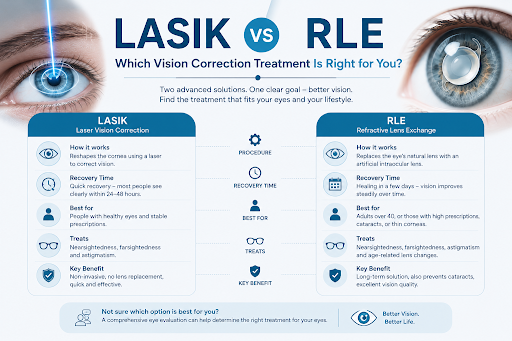
If you’re considering freedom from glasses or contact lenses, you’ve probably come across two popular vision correction procedures: LASIK (Laser-Assisted In Situ Keratomileusis) and Refractive Lens Exchange (RLE). Both can significantly improve vision, but they work in very different ways and are designed for different patients.
Choosing between LASIK and RLE depends on several factors, including your age, prescription, eye health, lifestyle, and whether you’re developing age-related changes such as presbyopia or cataracts.
This comprehensive guide explains the differences between LASIK and RLE, their advantages and limitations, recovery expectations, and how to determine which procedure may be right for you.
What Is LASIK?
LASIK is a laser vision correction procedure that reshapes the cornea—the clear front surface of the eye—to improve the way light focuses on the retina.
It is commonly used to correct:
- Nearsightedness (myopia)
- Farsightedness (hyperopia)
- Astigmatism
The natural lens inside the eye remains unchanged.
How LASIK Works
During LASIK surgery:
- A thin flap is created in the cornea.
- An excimer laser reshapes the underlying corneal tissue.
- The flap is repositioned without stitches.
The procedure usually takes 10–20 minutes for both eyes, with the laser treatment itself lasting only a few seconds per eye.
Benefits of LASIK
LASIK offers several advantages:
- Fast visual recovery
- Minimal discomfort
- Excellent success rates
- No stitches required
- Long-lasting results for stable prescriptions
- Quick return to daily activities
Many patients notice improved vision within 24 hours.
Limitations of LASIK
LASIK may not be suitable for everyone.
Potential limitations include:
- Does not prevent age-related reading vision changes (presbyopia)
- Does not prevent cataracts later in life
- May not be suitable for very high prescriptions
- Requires adequate corneal thickness
- Dry eye symptoms may temporarily worsen after surgery
What Is Refractive Lens Exchange (RLE)?
Refractive Lens Exchange, also called Clear Lens Exchange, is a procedure in which the eye’s natural lens is removed and replaced with an artificial intraocular lens (IOL).
The procedure is almost identical to modern cataract surgery, except the natural lens is removed before a cataract develops.
How RLE Works
During RLE:
- The natural lens is removed through a tiny incision.
- A customised intraocular lens is implanted.
- The new lens remains permanently inside the eye.
Unlike LASIK, RLE corrects vision by replacing the eye’s focusing lens rather than reshaping the cornea.
Benefits of RLE
RLE provides several important advantages.
Permanent Vision Correction
The implanted lens does not wear out and usually lasts a lifetime.
Prevents Future Cataracts
Because the natural lens has been removed, cataracts cannot develop later in life.
Corrects Presbyopia
RLE is particularly effective for patients who struggle with reading glasses after age 45.
Suitable for High Prescriptions
Patients with severe nearsightedness or farsightedness who may not qualify for LASIK can often benefit from RLE.
Limitations of RLE
Although highly effective, RLE is a more invasive procedure than LASIK.
Potential considerations include:
- Longer recovery period
- Small risk of retinal complications in highly myopic patients
- Requires intraocular surgery
- Reading performance depends on the type of intraocular lens selected
LASIK vs RLE: Side-by-Side Comparison
| Feature | LASIK | RLE |
|---|---|---|
| Procedure | Laser reshapes the cornea | Natural lens is replaced |
| Best Age | 18–45 years | Usually 45 years and older |
| Treats Presbyopia | No | Yes |
| Prevents Cataracts | No | Yes |
| Suitable for Thin Corneas | Often no | Usually yes |
| Suitable for High Prescriptions | Limited | Excellent option |
| Recovery | 1–3 days | Several days to a few weeks |
| Permanence | Long-lasting | Permanent lens replacement |
Who Is a Good Candidate for LASIK?
LASIK may be ideal if you:
- Are over 18 years old
- Have a stable glasses prescription
- Have healthy corneas
- Have mild to moderate refractive errors
- Do not yet have presbyopia or cataracts
Most LASIK candidates are younger adults seeking freedom from glasses for distance vision.
Who Is a Good Candidate for RLE?
RLE is often recommended for patients who:
- Are over 45 years old
- Need reading glasses due to presbyopia
- Have high levels of long-sightedness or short-sightedness
- Have early cataract changes
- Are unsuitable for LASIK because of thin corneas or other corneal conditions
What Types of Lenses Are Used in RLE?
One advantage of RLE is the ability to customise vision with different intraocular lenses.
Monofocal Lenses
Provide clear vision at one distance, usually far.
Reading glasses are often still required.
Multifocal Lenses
Designed to improve:
- Distance vision
- Intermediate vision
- Near vision
They can reduce dependence on glasses but may cause halos or glare in some patients.
Extended Depth of Focus (EDOF) Lenses
EDOF lenses create a continuous range of focus, offering excellent distance and intermediate vision with fewer visual disturbances than some multifocal lenses.
Toric Lenses
These lenses correct astigmatism while also treating refractive errors.
Recovery After LASIK
Most patients experience:
- Clearer vision within 24 hours
- Mild irritation for a few hours
- Return to work within one or two days
- Stable vision over the following weeks
Regular lubricating eye drops are usually recommended during recovery.
Recovery After RLE
Recovery is slightly longer.
Most patients notice:
- Vision improving within a few days
- Continued healing over 4–6 weeks
- Gradual adaptation to premium lenses if chosen
Your surgeon will prescribe antibiotic and anti-inflammatory eye drops during recovery.
Are LASIK and RLE Safe?
Both procedures have excellent safety records when performed by experienced ophthalmic surgeons.
Before recommending either treatment, your surgeon will perform comprehensive tests including:
- Corneal mapping
- Optical Coherence Tomography (OCT)
- Biometry measurements
- Tear film assessment
- Retinal examination
These investigations help determine the safest and most effective treatment for your eyes.
Questions to Ask During Your Consultation
Before deciding, ask your eye surgeon:
- Am I a suitable candidate for LASIK or RLE?
- Which procedure offers the best long-term results for my prescription?
- What lens options are available if I choose RLE?
- Will I still need glasses after treatment?
- What risks apply to my specific eye condition?
- How long is the recovery period?
A personalised consultation ensures your treatment aligns with your vision goals and lifestyle.
Final Thoughts
LASIK and Refractive Lens Exchange are both highly effective vision correction procedures, but they serve different patient groups. LASIK is generally the preferred choice for younger adults with healthy corneas and stable prescriptions, while RLE is often the better option for patients over 45 who want to correct both distance and near vision while eliminating the future risk of cataracts.
The best treatment depends on your age, eye health, prescription, and visual expectations. A comprehensive eye assessment with an experienced ophthalmologist is the most reliable way to determine which procedure is right for you.
Frequently Asked Questions
Is RLE better than LASIK?
Neither procedure is universally better. LASIK is often ideal for younger patients, while RLE is generally more suitable for people over 45 with presbyopia or early lens changes.
Can RLE prevent cataracts?
Yes. Because the natural lens is replaced during RLE, cataracts cannot develop in the treated eye.
Will I still need glasses after LASIK?
Many patients achieve excellent distance vision without glasses, but reading glasses may still be needed as part of the normal ageing process.
Which procedure has a faster recovery?
LASIK usually offers a faster recovery, with many patients returning to normal activities within one or two days. RLE recovery typically takes several weeks for complete healing.

